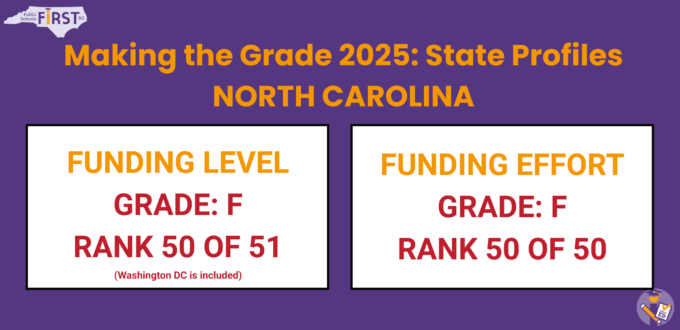
The Education Law Center’s Making the Grade 2025 report released on Wednesday highlights North Carolina’s continued neglect of public schools. North Carolina ranks 50th of 51 states (DC is included) for education funding. Only Idaho is worse. The report’s data is from the 2022-23 school year, so the rankings don’t yet account for stagnant spending over the past two years.
Making the Grade ranks states in three areas: funding level, funding distribution, and funding effort
Funding Level (NC Grade F; Rank = 50 out of 51). Funding level is determined by dividing combined state and local revenue for PK-12 education by student enrollment and adjusting to account for regional variation in labor market costs. In other words, the rankings account for the fact that some states are more expensive to live and work in than others.
North Carolina spent $5,660 per student less than the national average in 2022-23 ($12,193 in NC compared to the $17,853 national average). This is a drop from the previous year when NC spent $12,252 per student and ranked 48th worst in funding level.
Funding Distribution (NC Grade C; Rank = 17 out of 48). Funding distribution describes the relationship between district-level, per-pupil funding and student poverty in each state. In other words, to what extent does education funding help offset some of the inequities created by different levels of poverty in communities across the state? This is a drop from last year’s report which gave NC a B and a rank of 12. So while NC spends very little money on education compared to other states, NC distributes its few dollars more equitably than the majority of states.
Funding Effort (NC Grade F; Rank = 50 out of 50). Funding effort ranks states on effort measured as PK-12 spending as a percentage of the state’s economic strength—gross domestic product (GDP). Like funding level, the effort calculation includes both state and local funding. North Carolina ranks lower than all other states, dropping from the already abysmal 49 in last year’s report.
The legislature’s continued failure to adequately fund our public schools should be an embarrassment to all lawmakers standing in the way of a budget that includes major increases for public education.
