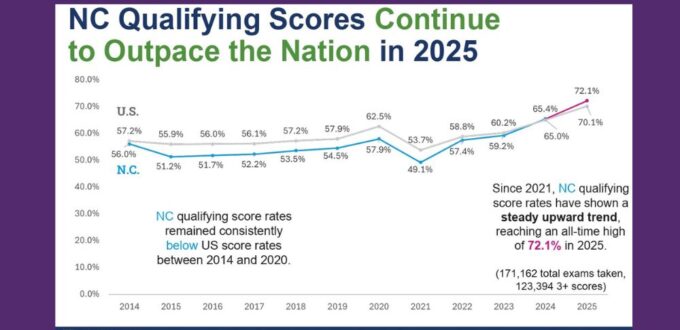
During its monthly meeting in November, State Board of Education members found out that public schools made state history this year. Record gains in Advanced Placement (AP) access and achievement are evidence that years of state investment are paying off.
Participation in AP courses, exam completion and number of qualifying scores of 3, 4, or 5 reached an all-time high in 2025.
A qualifying score on an AP exam provides college credit for the course at most colleges and universities, so these participation and qualifying score gains translate to substantial post-secondary cost savings for students and families.
NCDPI reported that in the 2024-25 school year, more than 97,000 students took at least one AP exam, a 7.3% increase from the previous year. Many students take more than one AP exam, and the number of total exams taken increased by 9.8% from last year.
North Carolina’s students also beat the national average for percentage of qualifying scores for the second year in a row. Of all the tests taken in North Carolina, 72.1% received a 3, 4, or 5 compared to 70.1% for the nation.
All racial and ethnic groups and genders contributed to the growth, highlighting the importance of North Carolina’s effort to expand opportunities and instructional quality. Growth was strongest among Black, Hispanic/Latino, and American Indian students. For example, participation in AP courses increased 7.5% for Black students and the number of qualifying scores increased 33.5%.
Hispanic/Latino student participation and qualifying scores also increased dramatically, but American Indian students grew the most. Their participation went up 15.8 % and qualifying scores increased 49.7%
All regions of the state have reason to celebrate. Every region showed significant growth in the number of tests taken and the number of qualifying scores. The Western region led in growth in the number of exams taken with a 17.5% increase while the Northeast region had the largest increase in number of qualifying scores, growing 28% over 2024.
These gains didn’t happen by chance. The state has provided purposeful, dedicated funding for advance course participation since 2015. General Statute 115C-174.26 requires the state to “enhance accessibility and encourage students to enroll in and successfully complete more rigorous advanced courses to enable success in postsecondary education for all.” These courses include AP and International Baccalaureate (IB) and other advanced courses. The statute also establishes reporting procedures to document progress and encourages the state to exempt students from paying exam fees.
To help build instructional capacity, lawmakers required the State Board of Education to develop a partnership with an organization such as the College Board to form the North Carolina Advanced Placement Partnership. This partnership provides technical assistance and professional development, summer training and AP mentoring programs.
The historic achievements in 2025 represent excellent ROI.
Unfortunately, some lawmakers are no longer interested in promoting advanced courses in public schools. The Senate budget proposal cuts the budget for exam fees and professional development by $17.9 million, effectively making advanced coursework and exam participation inaccessible for thousands of students.
The House budget keeps the AP/advanced coursework funding intact. With no budget yet in place, we don’t know whether the Senate or House version will emerge; funding for the programs is still uncertain.
As a point of comparison, FOUR PRIVATE SCHOOLS together received more funding through the Opportunity Scholarship voucher program than the total proposed cuts to the AP/advanced courses. These four schools received a total of $17,992,130 from the state in 2024-25:
- Grace Christian School, Sanford ($5,130,642)
- Metrolina Christian Academy, Indian Trail ($4,731,790)
- North Raleigh Christian Academy, Raleigh ($4,319,985)
- Concord Academy, Raleigh ($3,809,713)
These taxpayer dollars spent on private school tuition benefits students in just four schools have no public documentation of any academic benefit. In contrast, the AP funding has shown clear documented benefits for public school students throughout the state, including the college tuition savings for students who achieve qualifying scores.
Which is the better use of public funds?
Contact the budget negotiators (budget conferees) to encourage support for keeping full funding of advanced coursework and professional development. You can email all members at once by using our customizable email template.
Our Contact Elected Officials page also has letter templates for vouchers, teacher pay, and a “write your own from scratch” option. Let the budget conferees know your budget priorities!
