In their first meeting of the year, the Charter Schools Review Board reviewed 37 charter schools for renewals. Included in the group were the state’s two virtual charter schools, which were being reviewed for the first time since their launch in 2015. Initially started as pilot programs, their pilot status was extended multiple times despite poor performance.
The 2023 Appropriations Act (Section 7.26) extended the pilot program through the end of the 2025-26 school year, so to stay open, both statewide virtual charter schools had to undergo review this year. Legislation allowed the virtual charter schools to apply for a charter as “remote charter academies” (established as part of the 2023 Appropriations Act) and stipulated that remote charter academies could only be renewed for 5 years. The 3, 7, or 10-year renewals were not options, though the legislation did not provide a justification for the 5-year requirement.
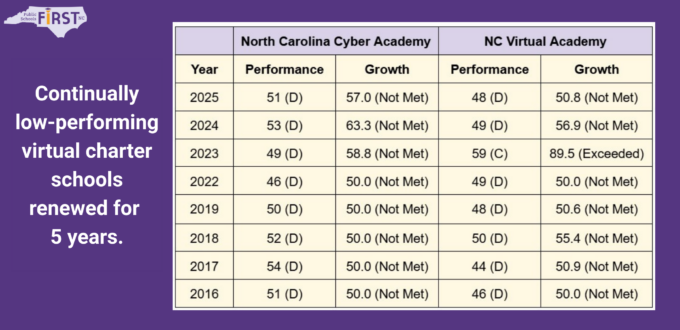
North Carolina Virtual Academy and NC Cyber Academy are chronically low-performing schools.
NCDPI defines low-performing schools as “those that receive a school performance grade of D or F and a school growth score of ‘met expected growth’ or ‘not met expected growth’ Continually low-performing schools have been low performing for two of the last three years.”
Except in 2023, when NC Virtual Academy received a C performance grade and Exceeded growth expectations, both schools have only received D performance grades and have Not Met growth expectations. (See School Report Cards for NC Virtual Academy and NC Cyber Academy.)
According to the Charter School Renewal Guidelines, neither school meets the criteria for receiving a 5-year renewal. Both clearly fail to meet criteria 5: The school is not currently designated as continually low-performing.
Adding complexity to the virtual charter school renewal is the question of why they have so much extra money. According to the NCDPI Office of School Business, by the end of 2025, NC Cyber Academy had $9.7 million and NC Virtual Academy had $16.0 million leftover funds. Why aren’t those funds being used to serve students?
For NC Virtual Academy, the answer may be found in the lawsuits currently pending against the organization that runs the school K-12—formerly Stride K-12— which is traded on the NY Stock Exchange. For example, in September 2025, a New Mexico school board sued Stride for fraud, deceptive trade practices, and systemic violations of law regarding mandated teacher-to-student ratios.
Investors have also sued Stride for inflating profit estimates and for enrolling “ghost students” to inflate profits and undercutting essential staffing requirements to boost profits.
With millions in unspent funds and chronically low-performing student achievement, these statewide virtual charter schools merit further examination by lawmakers who are interested in student educational quality and/or fiscal responsibility.
Senate Bill 371 (Stop Chronically Low-Performing Charters) was introduced in the 2025 long session to address some of the loopholes currently enjoyed by charter schools. For example, unlike traditional public schools, low performing charter schools are exempt from the requirements for school improvement planning.
A requirement for low-performing traditional public schools is the “development of a school or district plan for improvement that specifically addresses the strategies the school or district will implement to improve both the School Performance Grade and School Growth designation. These final plans are shared with the public, including parents, guardians, and staff and are made available through the local district website and the NCDPI website.”
Unfortunately, Senate Bill 371 was not advanced. Perhaps in the 2026 short session it will be revisited along with legislation to require accountability for private schools such as publicly available performance metrics.
