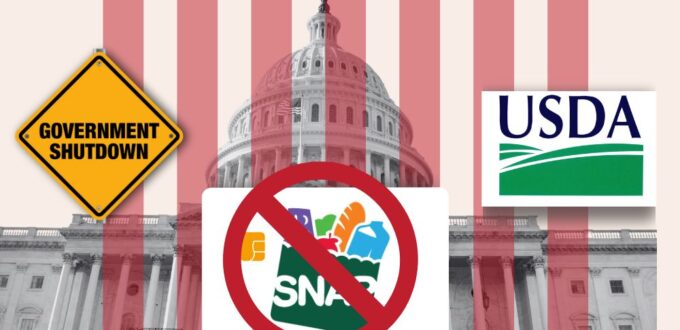
Now more than ever, the most important school supply—food—is at risk for hundreds of thousands of North Carolina’s students. On November 1, more than 1.4 million people in the state will lose critical food support provided through the federal Supplemental Nutrition Assistance Program (SNAP) as a result of the continuing federal government shutdown.
As of October 12, there are more than 582,000 children in North Carolina who rely on SNAP.
Every child needs enough food to be healthy and alert so they can do well in school. Educators know…hungry students struggle to learn; children who have access to healthy meals at home and at school are better equipped to learn and grow.
From 3% to 32% of the families in every county rely on SNAP benefits, which help low-income families buy groceries. Four out of every 5 families receiving benefits have either a child, a senior, or an adult with a disability living in the household. SNAP benefits are often used to provide food support when low-wage jobs leave families with too little income to pay for food as well as other expenses such as rent, medicine, clothing, and transportation.
Between 2019 and 2023, an average of 80% of SNAP households in NC included someone who was working. SNAP has work requirements for recipients ages 16 through 59.
In North Carolina, the minimum wage—set by state lawmakers—is just $7.25.hour. For employees who receive tips, the minimum wage is even lower. Employers are legally allowed to pay as little as $2.13 an hour to tipped employees as long as the employee receives enough in tips to make up the difference between the wages paid and $7.25.
Robeson County has the highest percentage of SNAP recipients (32%) with about 38,000 people relying on the program. In more populous Mecklenburg County, 130,000 residents rely on SNAP, making up 11% of the county’s population. The loss of SNAP benefits will increase food insecurity across every county in North Carolina, leaving our most vulnerable students without a source of stable, nutritious food.
On October 28, NC Attorney General Jeff Jackson joined 24 other states in a suit against the U.S. Department of Agriculture and the Office of Management and Budget, arguing that the agency should use the $6 billion it has in emergency funds to keep SNAP going during the shutdown.
On September 30, the USDA shared its Lapse of Funding Plan assuring states that no lapse in SNAP operations would occur. The Office Management of Budget’s legal experts had provided a letter to the USDA stating that “Congressional intent is evident that SNAP’s operations should continue since the program has been provided with multi-year contingency funds that can be used for State Administrative Expenses to ensure that the State can also continue operations during a Federal Government shutdown.”
However, on October 24, states received a new memo from the USDA reversing the earlier guidance and directing states to end all SNAP payments on November 1. The new memo also stated that if states choose to make SNAP funds available by using state dollars, the state will not be reimbursed after the shutdown ends.
The multi-state lawsuit is in response to this recent memo by the USDA to end all SNAP funding during the shutdown.
In states across the nation, lawmakers have taken steps to help address the SNAP funding halt. For example, Louisiana lawmakers authorized $150 million in state funding to make sure the state’s SNAP recipients receive their full benefit amount.
New Mexico held a two-day special legislative session to take measures to bolster food banks and pantries and allocate $17.5 million to SNAP-related costs to offset pending cuts. New Mexico’s state House Speaker said lawmakers are willing to approve more funds because “children going without basic food staples is an emergency.”
Virginia announced a substitute program that will send state funds to SNAP recipients’ benefits cards during November.
North Carolina’s lawmakers have not yet been proactive in addressing the looming SNAP cuts, but Governor Stein announced on Thursday that his office and a group of donors will be sending $18 million to food banks across the state. Compared to the $230-$250 million in federal benefits distributed each month, the $18 million won’t go far, but it is a start.
State lawmakers must take action, and communities can help fill the gaps.
We can all donate to our local food banks. We can help stock mini free pantries in our communities (or even start one if there isn’t one near you).
Please contact state and federal lawmakers to urge them to take action.
US lawmakers can pressure the USDA to release SNAP emergency funds. They can also take action to end the federal shutdown. Write an email to your US Congress members here.
State lawmakers can allocate funds to fill gaps in the federal SNAP funding. Write an email to your state lawmakers here.
